
Surely you’ve seen those social media BOGO ads offers, something like, “Spend $500 on advertising, get $500 in ad credits—for free!” It’s mighty tempting, so you leap. After all, what’s a $500 investment if you can potentially move thousands of dollars’ worth of product? You work through the ad creation process, or maybe you hire a copywriter and designer. Then the ads fly for two weeks, because that’s all the time you get to spend your $500 and the social media company’s $500. But in the end, there’s nada. Zip. Zero. Not one sale (#truestory; #learnedmylessonthehardway).
What’s a brand supposed to do when ads don’t work? Don’t be mad at me for saying so, but from the buyer’s side, your ads are likely annoying. They’re definitely interruptive and disruptive. And combined with all the other ads out there, they feel… relentless. So, it’s only natural for people to skip them. To block them. To scroll right past your ad without a second glance.
But what if I told you that there is a way to get people to pay attention? What if I told you that by using a different type of ad, you could build trust in your brand, help people feel good about saying yes and possibly even achieve a 29% conversion rate? Yes, please!
The type of content I’m talking about is user-generated content (UGC). In this article, I’ll tell you what it is, introduce you to UGC experts making bank with their ads and give you a proven process for putting UGC marketing to work for yourself.
What UGC marketing actually is (and why it works so well)

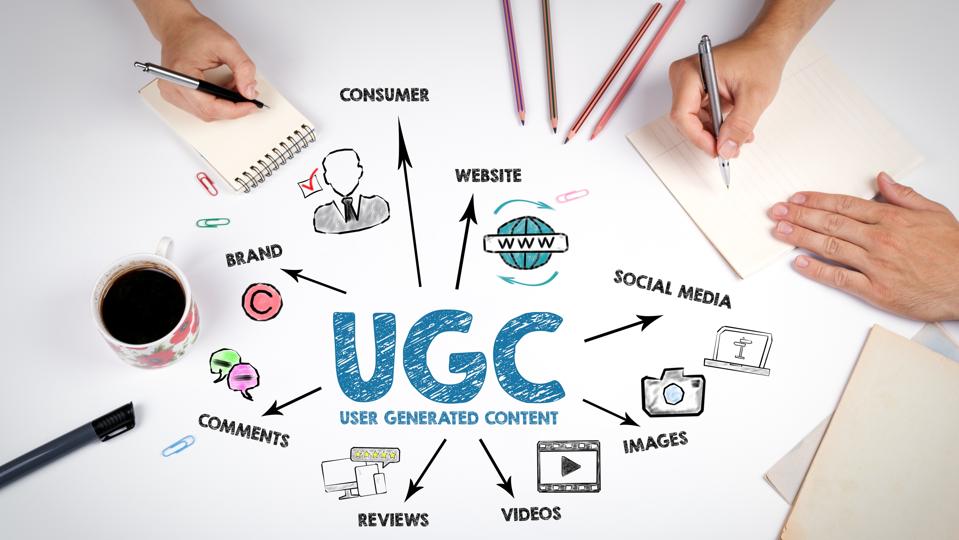
User-generated content is basically your customers doing your marketing for you. It's where customers tag, mention or feature your brand in social posts. Think product reviews where people can't contain their excitement, unboxing videos shot in someone's actual living room (not a studio), before-and-after photos that make you go, “Wait, is this the same person?”, that sort of thing. The common element is that real people who really buy, use and love what you sell create the content.
GoPro nailed UGC from the start. Instead of hiring production teams for beaucoup dollars, the brand runs open challenge campaigns where users submit footage of themselves skydiving, surfing and mountain biking. Those authentic moments become powerful ads.
Also, look at Glossier. Emily Weiss built her billion-dollar beauty brand by encouraging customers to post honest reviews and share real experiences. She didn’t care about perfect lighting or professionally applied makeup. She just wanted real people in real bathrooms talking about products that actually worked.
The psychology is simple: When potential customers see genuine people—not buff actors or beautiful models—using and loving your product, it's like our neighbor telling you about the face cream that actually got rid of her wrinkles—you know you’re going to try it. That’s because UGC answers the question every buyer has: "Will this actually work for someone like me?"

But here’s the thing: Not all brands approach UGC the same way. Some dabble, posting a few customer photos, resharing a tagged video and hoping for a bump in engagement. Others dominate because they treat UGC like a system, not a side project.
The difference shows up in the data. Today, 86% of companies use UGC marketing, and the industry is projected to grow from $5.4 billion to $32.6 billion by 2030. That kind of momentum tells us that UGC isn’t a fad. It also raises the stakes. More brands will be entering the space, and not all of them will succeed because with UGC, pretty doesn’t always mean profitable.
That Instagram-perfect photo with thousands of likes? It might be doing diddly squat for your bottom line. Meanwhile, a grainy kitchen video shot at 6 a.m. could quietly lead to dozens of sales because people don’t want perfection. They want to see themselves. Proof that your product works in real lives, messy mornings and all.
That mindset shift—from “does it look good?” to “does it convert?”—is what separates the dabblers from the dominators. And one founder has made it his mission to help brands make that shift.
From micro-influencers to millions: How one company cracked UGC marketing

Donatas Smailys and Tadas Deksnys know what it's like to throw marketing money into a black hole. Back when they were running a micro-influencer agency in the Baltics, every campaign felt like a gamble. "The whole space got very crowded, hard to measure and noisy," Smailys says. "We weren't capturing as much market as we thought we could."
Sound familiar? It's the same frustration many business owners feel: You spend money on content and ads, cross your fingers and hope something sticks.
One day, Smailys and Deksnys had an insight that changed everything: Follower count doesn't equal sales. They discovered that you could throw thousands of dollars at an influencer with a large following, but still not hit your sales goals. That realization became the foundation for Billo, the UGC platform the pair co-founded in 2020. Instead of obsessing over follower counts and Instagram-perfect content, Billo focused on one thing: creating videos that drive sales.
Five years later, that focus has paid off. Smailys says that Billo has produced more than 200,000 UGC videos, with brands spending hundreds of millions of dollars on ads through the platform every year. Only now, the Billos team no longer calls Billo a UGC platform. "We've evolved into what we call a 'full-scope creator marketing stack’ that turns UGC creators into a predictable sales channel for brands," Smailys says. Turns out, that shift in thinking—from content creation to systematic sales—is what separates the brands that dabble from the ones that dominate.
The UGC marketing system that turns content into conversions

Here's what I see happening with many brand marketers and UGC: They periodically throw random customer content at the wall like they're Jackson Pollock, hoping something sticks. A video here, a photo there. Maybe they’ll repost a customer’s video if it gets good engagement. Then they wonder why their UGC strategy feels more like chaos than growth.
Smailys and Deksnys figured out something different. Instead of random content creation, they built what they call a four-step loop: Create, tag, assess, iterate. It turns UGC marketing from a guessing game into a system that gives you real data you can use to make smarter decisions.
Here’s how it works.
UGC marketing step 1: Pick UGC creators who actually move product

Most brands start their UGC marketing journey by brainstorming what they think will work—a hook that “feels right,” a creator whose look matches the brand vibe. It’s guesswork, and it often leads to expensive misses. Billos takes a different approach. "When someone drops a product URL into our system, our AI builds a brief and matches it to a creator who's proved they can deliver results for similar products," Smailys says.
See what's not happening here? No sitting around a conference table going, “Well, she just feels right for our brand.” No picking creators because they have great hair or 100,000 followers.The matching happens based on data about which creators actually drove sales for similar products.
See the difference?
UGC marketing step 2: Tag everything so you know which UGC is working

Making the video is the easy part. Figuring out why it worked? That's where the money is. Too often, brand marketers throw UGC into the mix and cross their fingers. You're basically throwing spaghetti at the wall and praying something sticks.
Step two is where you decide to stop playing guessing games. "We tag every video with the same elements: hook, angle, call-to-action, format and category," Smailys says. "That way, when we see what performs, we know exactly why it worked."
Tagging turns vague wins into clear insights. Instead of saying, "That video did well," you’ll be able to say, "Videos with problem-solution hooks in vertical format with soft CTAs convert 40% better for this product category."
Now you’re cooking with gas.
UGC marketing step 3: Look at the numbers

Most people get seduced by likes, shares and comments here. Don't. Those things may feel good, but they don’t pay the bills. It’s a classic trap. A video gets tons of likes and comments, so it must be working, right? Not necessarily. You can have a video that goes viral but doesn’t convert a single customer, while a smaller video with 500 views might generate 50 new sales. The 500-view video made you money. The viral one didn’t.
Billo insists on a razor-sharp lens. "We track return on ad spend, click-through rates and hook rates, metrics that directly affect your bottom line," Smailys says. "Then we benchmark against past performance and industry standards."
Syed Ali Salman Bokhari, founder of Daily Vertex, a social media management company, has spent years helping brands measure UGC performance. His advice? “Track revenue earned from each UGC asset. Most brands look at revenue per campaign, but they don’t measure it at the individual post or video level.”
Track this stuff for two weeks and you'll see the pattern. “It’ll become obvious which 10% of content is responsible for 80% of your revenue,” Bokhari says. “That shifts your focus from creating more content to rinsing and repeating what already works.”
Bokhari watched this play out with a fitness gear startup paying dozens of micro-creators for stylish workout content. The videos looked great, but sales stayed flat. When the company added trackable links, they discovered that just two creators—each with fewer than 5,000 followers—were responsible for 70% of UGC-driven sales. “The brand shifted its budget to repurpose those creators’ content into ads,” Bokhari says. “Revenue doubled in six months.”
Now that’s powerful.
UGC marketing step 4: Rinse and repeat what works
For the Billos team, content that converts isn’t the finish line; it’s the starting point for smarter variations. The key is to study what works, steal it and keep testing. Billo’s AI automates this step by suggesting next actions—new hooks to test, edits to try, variations to create. Then it produces those iterations and pushes them back to ad accounts.
Bottom line: You stop guessing and start knowing what works.
Why UGC marketing needs AI in the back and humans up front

Here’s the deal with AI. Billo uses AI behind the scenes, not in your feed. The tech writes better briefs, matches brands with the right creators and suggests smarter edits, but the faces, voices and stories stay 100% human.
Even as other platforms seem to be pushing computer-generated avatars and “creators,” Smailys says Billos won’t touch them. “UGC works because people trust people,” he says. “Once your grandmother realizes that the person talking about those supplements she bought was computer-generated, she’s going to be furious. And that fury will land squarely on your brand.”
Case study: UGC marketing really does beat guesswork
Want to see how it works in action? Smailys told me about a skincare company that was bleeding money on Facebook ads. They'd tried everything—professional photoshoots, influencer partnerships, even celebrity endorsements—but they were still dabbling without a system. Their cost per acquisition kept going up.
"They came to us spending $50 to acquire each customer," Smailys says. "Within three months of implementing our create-tag-assess-iterate system, they brought it down to $18." The difference wasn't a better product or a bigger budget. It was treating UGC like a science, not a shot in the dark.
UGC marketing from the creator's perspective

For UGC creators doing the work, the pattern is clear. Professional UGC creator Alexandra Zyrianova has been making UGC content for brands for nearly five years, and her experience backs up what the Billos team preaches. "The most powerful UGC combines emotion and tangible results," she says. "Honest reviews and before/after examples consistently outperform highly polished creative."
She's seen it repeatedly. Brands obsess over perfect lighting and flawless editing, only to see simple, authentic testimonials shot on phones perform better. "The highest-return format is video testimonials with product demos—they’re authentic, emotional and packed with proof,” she says.
The moola question: Should you pay for UGC?
User-generated content started as pure word-of-mouth, with customers posting just because they loved a product. When that happens for your brand, it’s gold. But you can’t build a strategy or predictable revenue on luck.
Creators like Zyrianova aren’t just snapping selfies for fun. They’re writing scripts, shooting videos and editing content. They’re professionals. Which, yes, means you might need to pay them. That’s right—there’s a whole slew of people out there making money as professional UGC creators. You can find them looking for work on platforms like Billo, Insense and Cohley.
The good news? Paying for UGC is usually cheaper than traditional production. And when you track the performance of individual posts, you'll quickly see whether those dollars are turning into sales. It’s not an expense. It’s media spend that actually converts.
Four moves to start your UGC marketing system
If you’ve read this far, you’ve got a solid foundation. Now, here are four simple moves to put the system into action. No massive budget or fancy team required.
- First things first, track everything. Before anyone shoots a single video, set up your tracking. Use discount codes, UTM links or even a simple survey asking how people heard about you. Without that information, you'll have content but no clarity.
- Who’s already talking about you? Don't start with strangers. Find who's already posting about your product. Reach out: "Want to make it official?" That's your starter pool of creators.
- Think like a scientist here. Drop the "that looks nice" mindset. Run small tests across different hooks, angles and formats. Keep the winners, toss the rest.
- When something works, milk it. Don’t let a video that converts die in your feed. Turn it into ads, brief new creators to rework the winning formula and double down until returns taper off. Then test again.
The bottom line
Your customers are ready to become your best marketers. The question isn't whether customers can create content about your brand. They can and often do. The real question is whether you'll treat that content like strategic growth material or just another social media post.
Look, you can keep throwing content at the wall and hoping something sticks. Or you can start treating UGC marketing like the growth engine it actually is. So stop dabbling. Start systematizing. That’s how you’ll turn UGC into conversions and customers.